HOMILY WEEK 27 04 – Year II
Faith Expressed Through Prayer
(Ga 3:1-5; Lk 1:69-75; Lk 11:5-13)
*********************************************
There is a saying, “Pray as if everything depended on God; work as if everything depended on you.”
That saying resonates with the readings today, inviting us to place our faith in Jesus’ death and resurrection, and to persevere in prayer.
St. Paul, in his letter to the Galatians, comes close to exasperation as he confronts the Galatians to live by faith rather than relying on their own efforts. Paul is very upset at the Galatians for slipping into semi-Pelagianism – thinking they could somehow earn their way into heaven, or thinking they had to do that, instead of humbly and graciously receiving the gift of eternal life as a transformative act of faith in Jesus and the Holy Spirit.
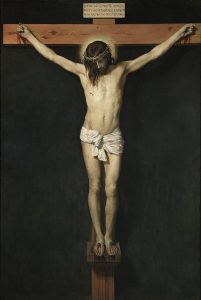
Diego Vela
“It was before your eyes that Jesus Christ was publicly exhibited as crucified!” Paul exclaims. That crucifixion encompasses the passion, death, resurrection, appearances and ascension of Jesus, and the outpouring of the Holy Spirit at Pentecost that transformed a huddled band of fearful followers into fearless proclaimers of good news as the Church. That, for Paul, is the core of our faith which is all pure gift, to be believed in and received with gratitude, and in no way to be earned by human effort.
The responsorial canticle is the Benedictus prayed every morning in the Divine Office, from the gospel of Luke. God fulfilled his promise to send a mighty savior to give us the knowledge and experience of salvation by saving us from our enemies. Those enemies are our sins, the wrongs we committed, and our sinfulness, that which made us do it. That sinfulness is our painful emotions, negative attitudes and addictions, more powerful than we are, so we need a savior. Those who know this best are the addicted, who know how powerless they are over that addiction, and who make their own Step One of their program – “Admitted we were powerless over alcohol, that our lives were unmanageable.”
As the Messiah, Jesus came to redeem and to sanctify, to forgive and to heal. Faith invites us to turn to him in prayer, to do for us that which we cannot do for ourselves. Our response to this gift of salvation, as the psalm puts it, is to lead holy and righteous lives, forgiven and healed. Holiness is a transformed way of being that is done unto us through humble repentant faith, more so than the result of any effort on our part. One way to express that reality is to say that salvation is more a matter of gratitude than grit, of receiving more than earning.
I have heard one older layman, in my youth, declare that one must merit heaven, or earn it. Interestingly, the Catechism of the Catholic Church has this to say about merit: “The merit of humans before God arises from the fact that God has freely chosen to associate man with the work of his grace” (#2008). “The merits of our good works are gifts of the divine goodness. Grace has gone before us; now we are given what is our due … Our merits are God’s gifts” (#2009). “Since the initiative belongs to God in the order of grace, no one can merit the initial grace of forgiveness and justification, at the beginning of conversion. Moved by the Holy Spirit and by charity, we can then merit for ourselves and for others the graces needed for our sanctification, for the increase of grace and charity, and for the attainment of eternal life” (#2010).
Admittedly, it is a fine balance between God’s grace and our response to that grace by cooperating with it. A slogan from the movement of A.A. is fitting here – we are to “Let go and let God.” This also connects with Step 11 of the same program: “Sought through prayer and meditation to improve our conscious contact with God, seeking only the knowledge of God’s will for us and the power to carry it out.”
This leads us to the gospel in which Jesus teaches two key things: Persistence in prayer, and to pray for the Holy Spirit, the greatest of gifts. When we pray in this way, for what God wants to give us anyway, the Holy Spirit, our prayer will always be answered, although often not in the ways we might expect them to be answered.
The prayer that captures this spirit of faith in the power of God working through our powerlessness is the prayer of the Anawim, the poor people who know they need God. That is the prayer Peter learned when he began to sink while walking on the water. His faith in Jesus, expressed by the more proud and heady prayer, “Lord, make me come to you” instantly deepened and became a humble, powerless cry from the heart, “Lord, save me!” And Jesus was there to pick him up and ask, “Why did you doubt?” I am sure that Peter never let go of Jesus and walked together with him back to the boat. In the movie series The Chosen, Peter hangs onto to Jesus even when back in the boat, crying out, “Please, don’t let me go!” And that is what we must do, turn to him every morning, humbly admit our need for the help of his Spirit, and walk with him in the Spirit throughout our day.
The Eucharist is our greatest prayer, and a vigil we are to persistently celebrate until Jesus comes again. As Ron Rolheiser OMI wrote, the Eucharist is our one great act of fidelity. Two thousand years ago, Jesus took bread and wine, transformed them into his body and blood, and asked us to continue to do this in memory of him – and we have done so, for over two millennia, and are doing so today.
May our celebration deepen our faith in Jesus as Lord and Savior and help us to persist in prayer to him and for the world.